
By the Ticket Dismissal HQ editorial teamReviewed Oct 21, 2026Sources cited at the endNot legal advice
A Texas defensive driving course is a six-hour, TDLR-approved course that can support dismissal of an eligible traffic ticket after court authorization or an insurer’s defensive-driving discount program. Course approval and court eligibility are separate. It costs $28 ($25 course plus a $3 minimum charge for materials, supervision and administration, the minimum set by Texas law), most people finish it in one evening, and the certificate is delivered to you electronically when you’re done.
Quick answer
- Cost: $28 minimum by law ($25 course + $3 minimum charge for materials, supervision and administration). Anything higher is the provider’s markup or a premium format.
- Length: 6 hours (5 hours of course time plus required breaks). Self-paced; log in and out as you like.
- Who approves it: Texas Department of Licensing and Regulation (TDLR). Only TDLR-approved courses are accepted by courts and insurers.
- For a ticket: you must get the court’s permission first, then you usually have 90 days to complete the course and submit your certificate and driving record.
- Our pick: DefensiveDriving.com — TDLR-approved, $28, instant certificate, and they’ll pay your ticket (up to $250) if the court doesn’t dismiss it.
DefensiveDriving.com Our pick
$28- TDLR-approved course; confirm court authorization before enrolling
- Shortest course allowed by law (6 hours); text course $28 all-in, video $38
- Instant certificate download plus free mail or FedEx delivery
- Provider advertises a ticket-dismissal guarantee (up to $250); check written terms and exclusions
- Online since 2000; 114,000+ reviews averaging 4.7/5
We may earn a commission if you enroll through this link, at no extra cost to you. How we make money.
What a Texas defensive driving course actually is
Texas officially calls it a driving safety course (DSC). Courts, the DPS, and insurance companies use that term; providers and drivers say “defensive driving.” They are the same thing. The curriculum is set by TDLR and covers Texas traffic law, crash avoidance, following distance, alcohol and drugs, distracted driving, and the state’s points and surcharge history. Every approved course teaches the same material; what differs is the format, the price, and how quickly you get your certificate.
Since 2018, TDLR has regulated the courses (before that it was the Texas Education Agency, which is why you’ll still see “TEA-approved” on some older sites). A course is only valid if it appears on TDLR’s approved list, and your certificate must be the uniform TDLR certificate of completion.
Three reasons Texans take it
1. Dismiss a traffic ticket
This is why most people are here. If you’re eligible (see below), a Texas court must let you take a driving safety course to dismiss a moving violation. If you complete the approved course and satisfy the filing requirements, the court dismisses the eligible charge rather than leaving a conviction for that offense. Texas law protects against a premium increase because of the dismissal; course completion may still be reported to DPS. You still pay the court’s costs (these vary by court; the administrative fee for the course request itself is capped at $10 by statute) plus the $25 course.
2. Get an insurance discount
Texas insurers commonly offer a discount, often up to 10% for three years, when you voluntarily complete a defensive driving course. You don’t need a ticket to do this. Check with your insurer first: the discount, and whether it applies to your policy, is up to them, not the state.
3. Satisfy a court order or employer
Some judges order the course as a condition of deferred disposition, and some employers require it for staff who drive. The same TDLR-approved course covers both.
Are you eligible to take it for a ticket?
Under Texas law, the court must grant your request if all of these are true:
- You hold a valid, non-commercial Texas driver’s license or permit (or are a military member/dependent stationed in Texas).
- You have not completed a driving safety course for ticket dismissal in the past 12 months.
- The ticket is for a moving violation that is not: speeding 25 mph or more over the limit, any speed of 95 mph or more, passing a stopped school bus, leaving the scene of a crash, reckless driving, fleeing from police, or a violation in a construction zone with workers present.
- You have current liability insurance (you’ll show proof of financial responsibility to the court).
- You were not driving a commercial vehicle and do not hold a CDL.
You qualify? Start the course →
You must ask the court before or on your appearance date printed on the ticket. Don’t take the course first and hope: if you complete it without the court’s permission, the court can refuse the certificate. Request first, then enroll.
If you don’t qualify, or you’ve already used your once-a-year dismissal, deferred disposition is usually the next-best option. Full details on eligibility are in our Texas requirements guide.
How to dismiss your ticket with the course, step by step
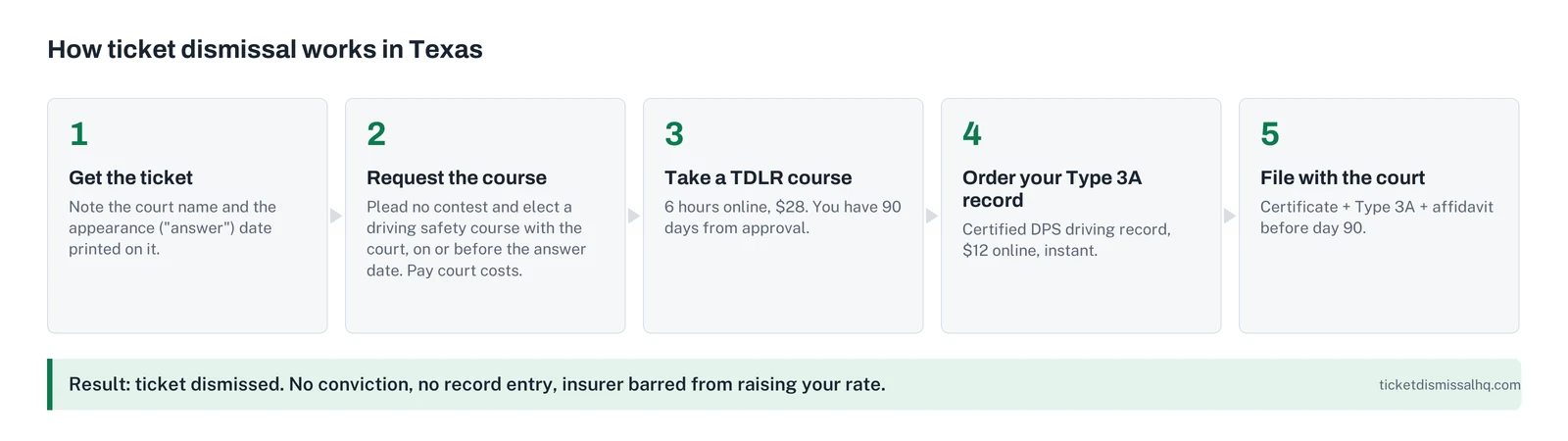
- Request permission from the court. Before your appearance date, plead “no contest” or “guilty” and ask for a driving safety course. Most Texas courts let you do this online, by mail, or in person. Bring or upload your Texas license and proof of insurance.
- Pay the court costs. The court collects its court costs plus a driving-safety-course administrative fee, which state law caps at $10. Total varies by court; ask the clerk for the exact figure. This is separate from the course price.
- Take a TDLR-approved online course. You’ll typically get 90 days. The course is self-paced, so an evening or a weekend is plenty. DefensiveDriving.com is our pick because it’s $28, the certificate is instant, and it satisfies TDLR’s course requirement; court approval of your ticket dismissal is separate.
- Order your Type 3A driving record. Ask whether your court requires you to supply a certified Type 3A record. Under Article 45A.359, the judge may instead retrieve your record through the state portal. If you must order it, DPS lists a $10 base fee; an online transaction charge may apply.
- Submit the certificate and any other court-required documents before the deadline. Keep copies and confirm dismissal. The dismissed charge is protected by law, although the course-completion date can be reported to DPS.
Full walkthrough with court-specific tips: How to get a traffic ticket dismissed in Texas.
What it costs, all in
| Item | Typical cost | Who sets it |
|---|---|---|
| Driving safety course | $28 ($25 + $3 minimum materials and administration charge) | Minimum fixed by Texas law; premium formats cost more |
| Type 3A driving record | $10 base + online transaction fee (if required) | Texas DPS (online); some providers bundle it |
| Court costs + DSC administrative fee | Varies by court (admin fee capped at $10) | Each municipal or JP court; Code of Criminal Procedure art. 45A.352 |
| Certificate delivery | $0 (instant download) to $20+ (rush mail) | Provider — pick one with a free electronic certificate |
Compare that with paying the ticket outright ($150–$300 for typical speeding) plus the conviction on your record and a likely insurance increase for three years, and the course pays for itself many times over.
Choosing a course: what actually matters
- TDLR approval. Non-negotiable. Look for the TDLR approval on the provider’s site, or check the TDLR-approved list.
- Price. Legally the floor is $28 ($25 course + $3 minimum charge for materials, supervision and administration); video versions typically run $38. There is no reason to pay more than that for the same state-mandated curriculum.
- Certificate speed. Instant electronic delivery is now standard. Avoid providers that make you pay extra just to get your certificate on time.
- Format. Video-based courses are easier to sit through; some are text-only. Timers are required by the state on every course, so no provider is genuinely “faster.”
- Driving record bundle. Being able to order the Type 3A record at checkout saves a separate trip to the DPS site.
We compare the major providers on these points in our best Texas defensive driving course roundup and individual reviews.
Enroll in the $28 Texas course →
Frequently asked questions
Can I take Texas defensive driving online?
Yes. Online courses have been approved in Texas for over 20 years but for ticket dismissal you must qualify under the law and receive the court’s authorization.
How long is the Texas defensive driving course?
Six hours by law: five hours of instruction plus one hour of mandatory breaks. Providers cannot shorten it, so ignore ads claiming a “fast” course.
How many times can I take defensive driving in Texas?
For ticket dismissal, once every 12 months. There is no limit on taking it voluntarily for an insurance discount.
Does defensive driving remove points in Texas?
Texas ended its points-based Driver Responsibility Program in 2019. A dismissed ticket never becomes a conviction, so nothing is added to your record in the first place.
Is there a free Texas defensive driving course?
No. Texas law sets a $25 minimum for any approved driving safety course, so a “free” course cannot be TDLR-approved and won’t be accepted by a court or insurer.
Can my insurer raise my rates because I took the course?
No. Article 45A.357(b) of the Texas Code of Criminal Procedure bars insurers from cancelling a policy or raising premiums because you completed a driving safety course or had a charge dismissed under it.
What if I miss the court’s deadline?
Contact the court immediately. Some will grant a short extension if you ask before the deadline passes; after it, the court can enter a conviction. Do not wait.
Sources: Texas Code of Criminal Procedure art. 45A.352 (driving safety course dismissal procedures); Texas Department of Licensing and Regulation, Driving Safety program; Texas DPS driver record fees.