
By the Ticket Dismissal HQ editorial teamReviewed Oct 21, 2026Sources cited at the endNot legal advice
An eligible Texas traffic ticket may be dismissed after you request permission from the court and complete a TDLR-approved driving safety course. Contact the court named on your citation by the appearance date before enrolling. If the court grants your request, you generally have 90 days to complete the course and submit the required documents. Course pricing starts at $28; court costs and any required driver-record charge are separate.
Quick answer
- Ask the court first, on or before the appearance (“answer”) date on your ticket. Plead no contest or guilty and request a driving safety course.
- You qualify if you have a valid non-commercial Texas license, current insurance, haven’t used the course in the past 12 months, and the ticket isn’t for 25+ mph over, 95+ mph, passing a school bus, leaving a crash scene, or a work-zone violation with workers present.
- You generally get 90 days after the court’s authorization to finish a TDLR-approved course and submit the completion certificate and required paperwork. Ask if you must supply a Type 3A record; some courts retrieve it directly.
- Result: once the statutory conditions are satisfied, the court dismisses the eligible charge. Texas law protects against an insurance-premium increase because of the dismissal, though the course-completion date may be recorded.
DefensiveDriving.com Our pick
$28- TDLR-approved course; confirm court authorization for your ticket before enrolling
- 6-hour text course $28 all-in ($25 + $3 minimum materials and administration charge), video $38; finish in an evening
- Instant certificate download; Type 3A driving record can be added at checkout
- Provider advertises a ticket-dismissal guarantee up to $250; review written terms and exclusions
- Online since 2000; 114,000+ reviews averaging 4.7/5
We may earn a commission if you enroll through this link, at no extra cost to you. How we make money.
Who qualifies for ticket dismissal in Texas
The rules are in Chapter 45A, Subchapter H, of the Texas Code of Criminal Procedure, including Article 45A.352. Eligible timely requests must be granted, but the court must verify the specific statutory requirements. You qualify if:
- The offense is a moving violation under the Texas Transportation Code (speeding, running a red light or stop sign, failure to signal, following too closely, and so on). Non-moving violations such as expired registration, no insurance, or parking are not eligible.
- You hold a valid Texas driver’s license or permit (or you’re active-duty military, or a military spouse or dependent).
- You don’t hold a commercial driver’s license and didn’t at the time of the offense.
- You have not completed a driving safety course for dismissal in the 12 months before the offense date. The clock runs from offense date to offense date, not from when you took the course.
- You can show proof of financial responsibility (current liability insurance) to the court.
- The ticket is not for speeding 25 mph or more over the posted limit, any speed of 95 mph or more, passing a stopped school bus, failing to stop and render aid after a crash, or a violation in a construction zone when workers were present.
- You plead no contest or guilty on or before your answer date and request the course at the same time.
You qualify? Start the course →
If any of the above disqualifies you, you may still be able to keep the ticket off your record with deferred disposition, which is at the judge’s discretion rather than a right. Many Texans use the course for their first ticket and deferred disposition for a second one inside the same year.
The deadline that matters most
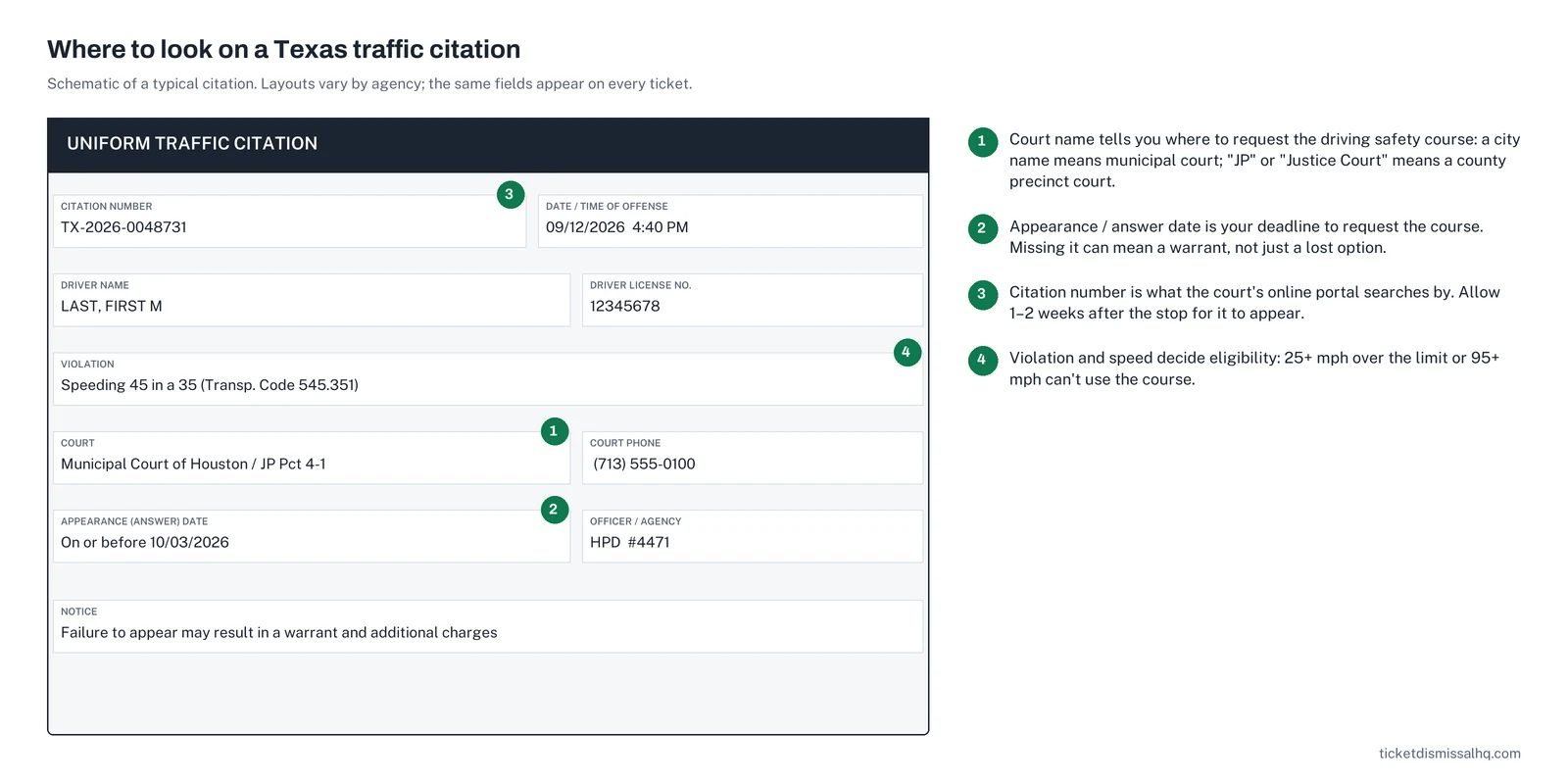
Your citation shows an appearance date, usually 10 to 20 days after the stop. That is the answer date, and the safe deadline for requesting the course. Under Article 45A.352(c), a court may grant a later request before final disposition, but this is discretionary. Missing it doesn’t just cost you the course option: the court can issue a warrant for failure to appear. If your date is close, contact the court today; most municipal and justice-of-the-peace courts accept the request by mail, email, or an online portal, and many let you handle everything without appearing in person.
Court permission first, course second. A certificate you earned before the court granted your request may be rejected, and providers won’t refund a course you can’t use. Get the court’s approval (or at least submit the request) before you enroll.
Step by step: dismissing your Texas ticket
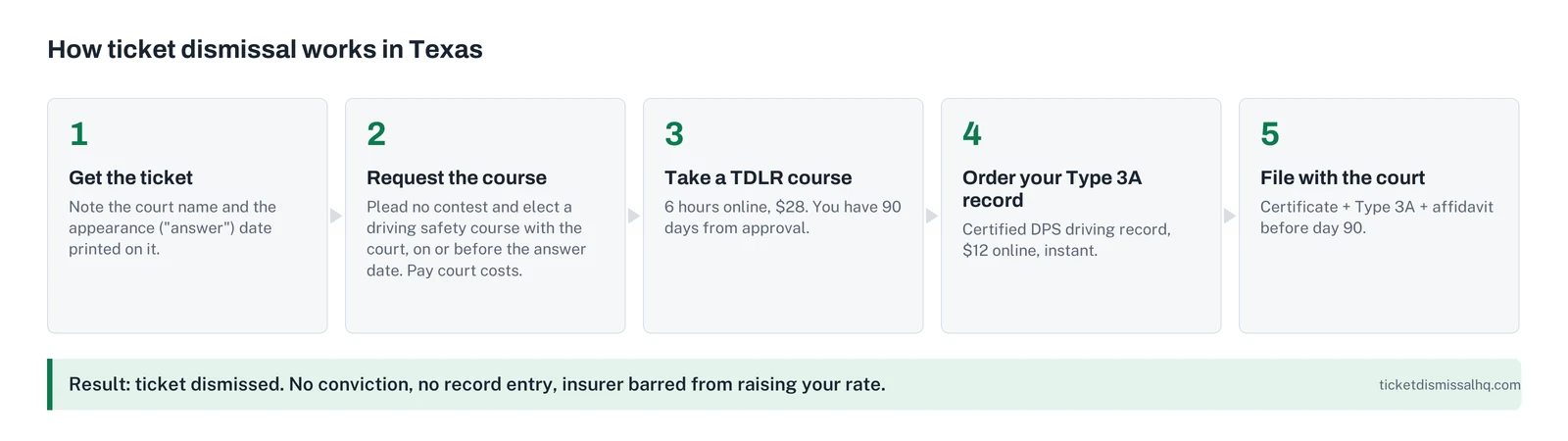
- Find your court. The citation names the court (a municipal court for city police tickets, a justice court for county deputies and DPS troopers). Look up its driving-safety-course page; most publish the exact fee and the request form.
- Submit the request by the answer date. Plead no contest or guilty and elect the driving safety course. Provide a copy of your Texas license and proof of insurance. Some courts also want a signed affidavit stating you haven’t taken the course in the past 12 months.
- Pay the court. You’ll pay the court’s costs for the offense plus a driving-safety-course administrative fee that state law caps at $10. The total differs by court, so ask the clerk. Paying this is not a fine and does not create a conviction.
- Take a TDLR-approved course within 90 days. The course is 6 hours, online, self-paced. Our pick is DefensiveDriving.com ($28 text, $38 video, instant certificate). Any course on the TDLR-approved list is accepted.
- Order your Type 3A driving record. Ask if your court requires you to supply a certified Type 3A record. Under Article 45A.359, a judge may obtain it through the state portal instead. If you must order it, DPS lists a $10 base fee, and online transaction charges may apply. How to get it.
- File the completion certificate and any other court-required documents before your deadline, including affidavits and a Type 3A record if the court requires you to obtain one. Deliver them the way the court specifies (in person, mail, or upload). Keep copies of everything.
- Confirm the dismissal. Most courts mail or email a dismissal notice. If you haven’t heard anything within two weeks of filing, call the clerk and ask them to confirm the case shows as dismissed.
What it costs versus paying the ticket
| Take the course | Just pay the ticket | |
|---|---|---|
| Court costs | Yes (varies by court) | Yes, plus the fine |
| Course | $28 | — |
| Type 3A record | $10 DPS base + any online transaction fee (if the court requires you to obtain the record) | — |
| Conviction on record | No | Yes, 3 years |
| Insurance impact | None (protected by statute) | Often a surcharge at renewal |
| Your time | About 6 hours online | None |
For a typical speeding ticket the course adds roughly $40 in out-of-pocket cost and an evening of your time, in exchange for no conviction and no insurance increase. Unless the ticket is trivial and you have a clean record you don’t mind marking, the course is the better deal.
Enroll in the $28 Texas course →
Common mistakes that get certificates rejected
- Taking the course before requesting it. Courts can and do refuse those certificates.
- Using a non-TDLR course. National “defensive driving” or insurance-discount courses that aren’t on the Texas list are worthless for dismissal.
- Submitting a Type 3 instead of a Type 3A. The court needs the certified version. Check the record type before you pay.
- A name mismatch. The name on your certificate must match your license and the citation exactly.
- Missing the 90-day window. Courts rarely extend it after the fact. Put the deadline in your calendar the day the court grants the request.
Frequently asked questions
Can I take defensive driving for a red light camera ticket in Texas?
No. Red light camera notices are civil penalties against the vehicle owner, not moving violations charged against a driver, so the course doesn’t apply (and Texas outlawed most camera programs in 2019). An officer-issued red light ticket is eligible.
Does the ticket show up anywhere after dismissal?
The court keeps a record that the case existed and was dismissed, but nothing is reported to the DPS as a conviction and nothing appears on the driving record insurers pull.
Can I take defensive driving twice in one year in Texas?
Not for dismissal. If you completed a course for a ticket within the 12 months before your new offense date, you’re ineligible, and the court will see it on your Type 3A record. Ask for deferred disposition instead.
I got the ticket in another Texas city. Which court do I use?
The court named on the citation, where the offense happened, not the one where you live. Everything can usually be done remotely.
What if I’m out of state or not a Texas resident?
A Texas driver license or permit generally meets the license requirement under Article 45A.352. The statute also covers specified active-duty military members and their spouses or dependent children. Other out-of-state drivers should ask the court about available options.
Sources: Texas Code of Criminal Procedure, arts. 45A.351–45A.359; TDLR course-fee guidance; Texas DPS Type 3A record fee.